
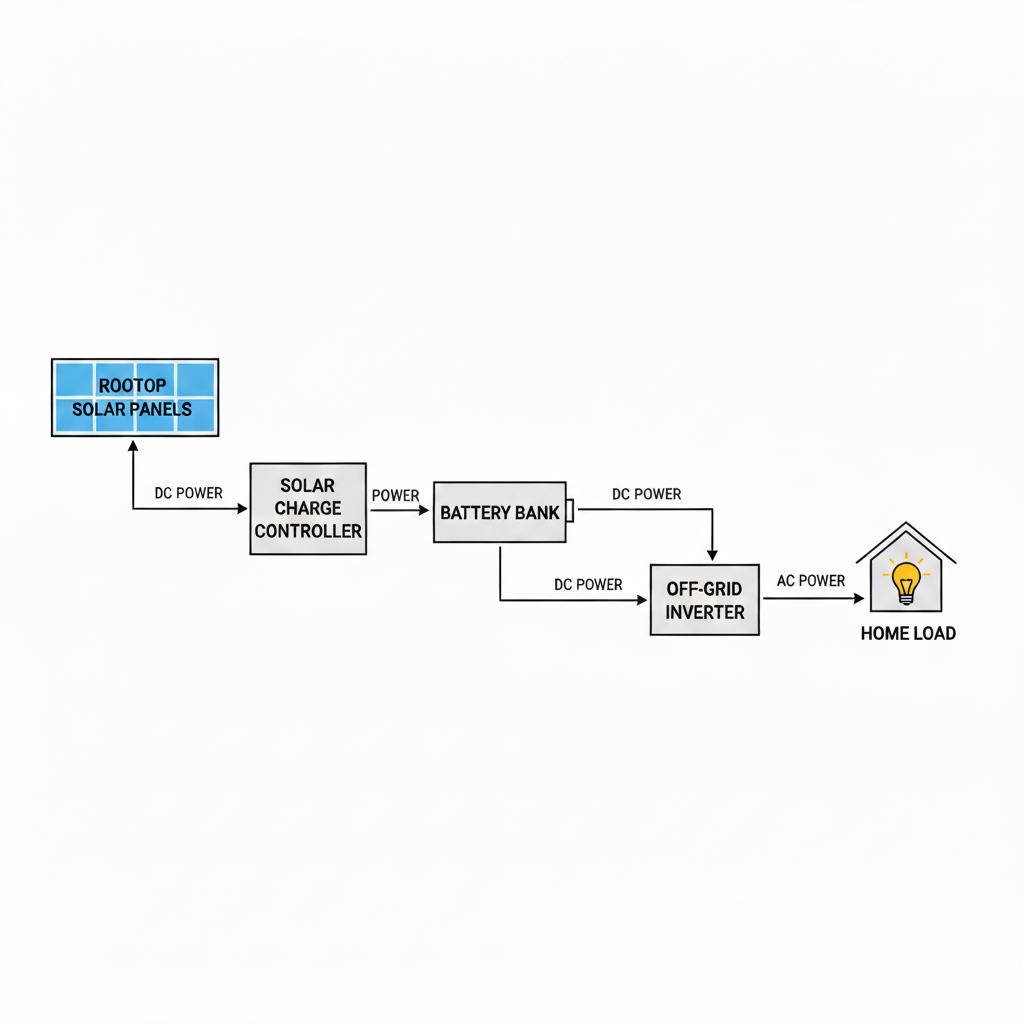
Overview of an Off-Grid Solar System
An off-grid solar system, also known as a standalone solar system, works on the same principle as an on-grid solar system: photovoltaic (PV) cells capture sunlight and convert it into electricity. However, the key difference is that an off-grid solar power system has no connection to the electricity grid. Instead, it uses batteries to store electricity generated by the solar panels during sunshine hours.
The off-grid solar system price in India is generally higher than that of an on-grid solar system. Additionally, maintaining off-grid solar systems requires more effort and cost because batteries are involved and must be replaced periodically to ensure smooth system operation.
Indicative Off-Grid Solar System Prices in India
3 kW off-grid solar system price in India: *₹2,40,000 onwards
5 kW off-grid solar system price in India: *₹4,50,000 onwards
Elixir Solar provides end-to-end off-grid solar system solutions, including design, installation, and support.
The prices mentioned above are indicative market estimates and may vary based on site conditions, battery type, and system configuration.
Ready to explore how an off-grid solar system works, understand pricing details, and decide whether it’s the right solution for you—especially when the Government of India offers subsidies for on-grid rooftop solar systems? Read on for complete details.
What Is an Off-Grid Solar System?
An off-grid solar system is a standalone solar power setup that generates and stores electricity without relying on the public utility grid. The electricity generated by solar panels is stored in batteries and used whenever required, day or night.
An off-grid solar system consists of the following key components working together:
Solar panels (modules)
Mounting structures
Batteries
Solar charge controller
Solar inverter
Solar accessories
When Should You Use an Off-Grid Solar System?
Most Indian homes do not require off-grid solar systems because their energy needs can be efficiently met by on-grid rooftop solar systems, which are more affordable and easier to maintain.
However, an off-grid solar system is ideal if:
You live in a remote location with no access to the electricity grid
Your area experiences frequent or prolonged power cuts
The grid supply in your area is unreliable
If you have a stable grid connection, an on-grid solar system remains the most economical and practical choice.
Components of an Off-Grid Solar System Explained
1. Solar Panels
Solar panels are made up of solar cells that convert sunlight into electricity. Based on construction, panels are classified as:
Monocrystalline panels: Made from a single silicon crystal, high efficiency
Polycrystalline panels: Made from multiple silicon crystals, cost-effective
Bifacial panels: Generate power from both front and rear sides
Off-grid solar panels generate DC electricity. Proper installation without shading is essential to achieve maximum performance.
2. Solar Inverter
Solar panels produce DC electricity, while household appliances operate on AC power. The solar inverter converts DC power into usable AC power and acts as the heart of the off-grid solar system.
3. Batteries
Batteries are a critical part of an off-grid solar system.
During the day, solar power runs appliances and charges the batteries
At night or during low sunlight, stored battery power supplies electricity
4. Charge Controller
The charge controller regulates electricity flow:
Manages power from solar panels
Prevents battery overcharging and deep discharge
Supplies regulated power to the inverter and batteries
5. Mounting Structures
Mounting structures securely hold the solar panels at an optimal tilt angle to ensure maximum sunlight absorption throughout the day.
6. Solar Accessories
Additional accessories ensure system safety and reliability:
DC cables and DC combiner box
AC cables and AC combiner box
MC4 connectors
Earthing strips and conduit trays
Lightning arresters
How Does an Off-Grid Solar System Work?
Step 1: Sunlight Absorption & Power Generation
Photovoltaic (PV) cells absorb sunlight and excite electrons, generating direct current (DC) electricity. Panels are connected in series and parallel to optimize voltage and current output.
Step 2: String Aggregation & Protection
Multiple panel strings are connected through a combiner box equipped with fuses or breakers. This ensures safety, fault isolation, and easy system monitoring.
Step 3: MPPT & Charge Regulation
The solar charge controller uses Maximum Power Point Tracking (MPPT) to continuously extract maximum power from the panels while managing battery charging stages—bulk, absorption, and float.
Step 4: Battery Bank Charging
The regulated DC power charges the battery bank:
Lead-acid batteries: Cost-effective but require maintenance
Lithium-ion batteries: High efficiency, longer lifespan, low maintenance
Step 5: Intelligent System Coordination
Modern off-grid systems enable communication between the inverter and charge controller to monitor battery state of charge, load demand, and system safety in real time.
Step 6: DC-to-AC Conversion
A pure sine-wave inverter converts DC electricity into high-quality AC power suitable for all household and industrial appliances, including sensitive electronics.
Step 7: Power Distribution to Home or Facility
The inverter supplies AC power through a breaker panel or Automatic Transfer Switch (ATS). Advanced systems prioritize critical loads and disconnect non-essential loads during low battery conditions.