
Elixir Solar started in 2015 with the desire to escalate the mass adoption of solar in India.
We’re now the third-largest EPC contractor in the country, having served 25,000+ homes and 250+ housing societies. Our services include:
The installation of on-grid rooftop solar systems for homes and housing societies
After-installation maintenance and after sales care
Varied EMI options for our customers
Using prefabricated mounting structures for the installation of solar panels
We closely work with our customers and build a legacy that will last for as long as your solar system will last (at least 25 years).
Overview of on-grid solar systems
An on-grid solar system is also known as a grid-tied system since it is connected to the main utility grid. One of the best things about installing on-grid solar at home is the subsidy you get. The Indian government offers homeowners a subsidy for installing a rooftop on-grid solar system ranging between Rs. 30,000 and Rs. 78,000 (depending upon the installed system capacity).
The on-grid solar system price varies from city to city and, of course, depends on the size of the system. Let’s give you a price demonstration from two different cities (one from North India and one from South India) to give you an idea about the on-grid solar system cost:
3 kW on-grid solar system price in Bhopal with subsidy: ~ Rs. 1,35,000
5 kW on-grid solar system price in Bengaluru with subsidy: ~ Rs. 3,00,000
Please note: The prices above are indicative as of 29th April 2025 for Elixir Solar Blue 6ft variant. The final on-grid solar system cost in India depends on your city, DISCOM charges, product variant opted for, panel type, system capacity, inverter type, mounting structure height, type of after-sales service, savings guarantee, roof height, etc. Also, prices are subject to change without prior notice.
In this article, we’ve threaded the ins and outs of on-grid solar systems for you: workings, price details with and without a subsidy, and installation tips. Dive in for details!
What is an On-grid Solar System?
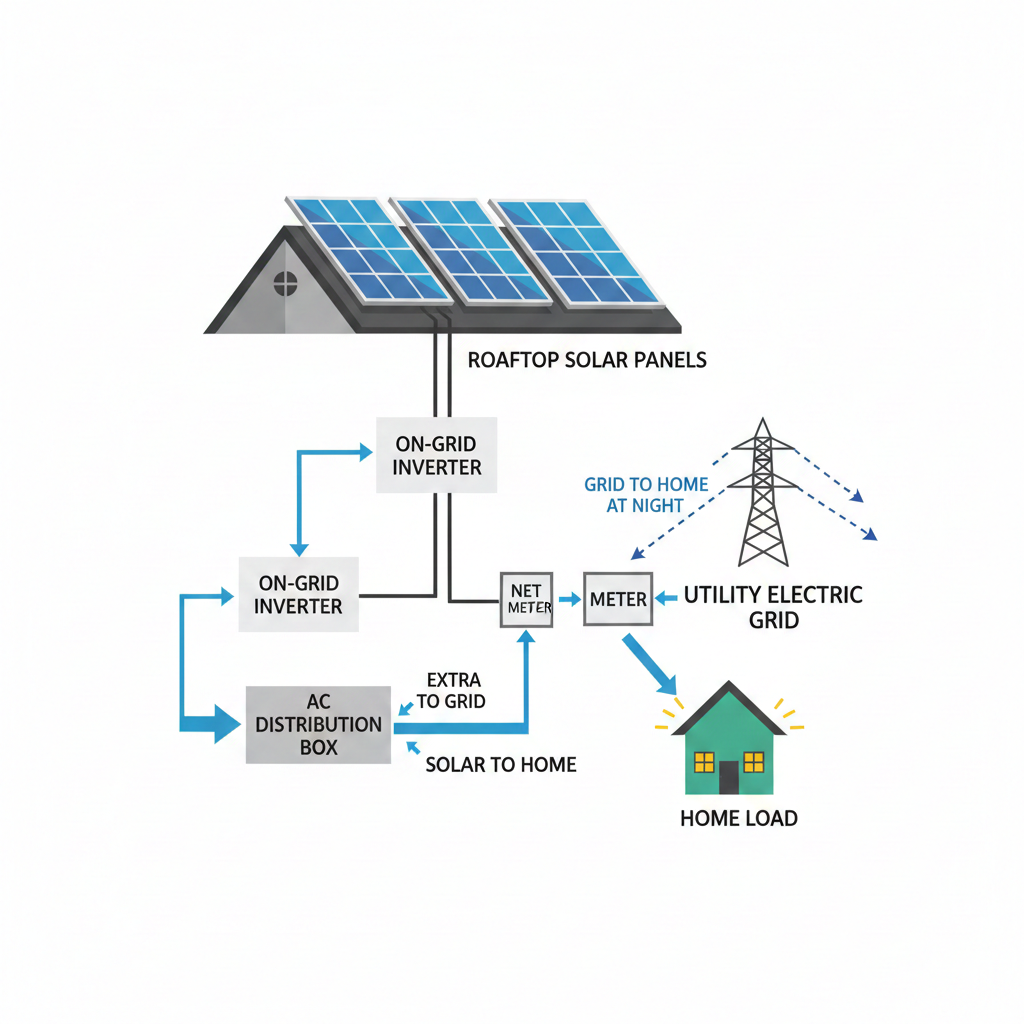
An on-grid solar system (grid-tied) connects directly to the utility grid through a bi-directional meter (net meter). Most Indian homes with a reliable grid connection choose on-grid solar since this system is powerful enough to support all household energy requirements.
The on-grid solar system is a careful compilation of many components, listed below, arranged together to convert sunlight into electricity:
Solar Panels
A solar inverter
Solar module mounting structures
A bi-directional meter
Solar accessories (AC and DC cables, AC and DC combiner boxes, conduit trays, lightning arrester, MC4 connectors)
Wondering what the individual role of these components is? Let’s break it down for you!
What Are the On-Grid Solar System Components?
Did you know? When maintained properly, an on-grid solar system can last for 25 years. Contrary to popular belief, cleaning your panels with sprinklers can actually damage them. To keep your system operating at its peak efficiency, be sure to sign up for professional after-sales services.
Here’s a breakdown of how every single component in an on-grid solar system comes together to power your home.
1. Solar Panels
Solar panels are the most visible part of the solar system. They’re installed on the rooftop, facing the South direction. When sunlight falls on these panels, they absorb that sunlight and convert it into electricity.
Did you know? Solar electricity directly from the panels is DC power. Since homes require alternating current (AC), a solar inverter is needed to convert direct current into AC.
2. Solar Inverter
Without a solar inverter, the entire solar system would have been an impractical model. The solar inverter converts DC into AC.
This conversion is essential because that’s the only way to convert electricity generated from an on-grid solar system into a usable form (AC) that can run household appliances.
3. Solar Module Mounting Structures
These are the pillars that support solar panels. They must be of a standard grade so that they can withstand heavy winds during storms and cyclones and hold the weight of the solar panels for 25 years (that’s the life of a solar system).
The best solar module mounting structures are prefabricated in precision labs. They’re coated with hot-dip galvanizing on steel to make them rust-proof.
For instance, Elixir Solar’s Intelligent WindPro Mount™ 2.0 mounting structure, which IIT-Bombay approved, can:
Withstand wind speeds as high as 170 kmph
Prevent rusting for years because they have a high-density galvanized iron (HDGI) coating of 80 microns to withstand corrosion.
4. Solar Accessories
They might not sound that important in the entire setup, but solar accessories are as important as a panel, an inverter, or a mounting structure. Let’s see how!
AC and DC cables: They are required for wiring solar panels and connecting different parts to make the entire solar grid functional.
DC combiner boxes: A DC combiner box works like an isolation box. All the cables carrying DC current from the panels are isolated in this box. DC power coming from the panels can be as high as 1,000 volts, even more. It’s dangerous (potentially lethal); hence, a DC combiner box is required. This box feeds the DC current into the solar inverter and the solar inverter produces alternating current.
AC combiner boxes: The AC power from the solar inverter is fed into an AC combiner box (all cables carrying the AC current from multiple inverters are combined in this box).
Earthing strips and wires: Once the entire on-grid solar system is set up, earthing is done using earthing strips and wires.
Please note: all the DC cable connections are made using MC4 connectors.
5. Bi-directional Meter
Also known as a net meter, the bi-directional meter is basically designed to keep a track of:
Electricity supplied to the grid
Electricity imported from the grid
An on-grid solar system will not become functional until and unless the regular meter is replaced with a bidirectional meter.
The net meter helps the discom track the power generated by the solar system, the power consumed, the power supplied to the grid, and the power imported.
At the end of every month, when the electricity bill is generated, the readings from the bidirectional meter give an account of:
How many units were supplied to the grid
How many units were taken from the grid
Here’s how this solar net metering process helps:
If you supply more units to the grid than you consumed, those units will be deducted from your bill. It will reduce the bill further.
If you use extra units from the grid in addition to what your solar plant generated, those units would be added to your bill.
How Does an On-grid Solar System Work?
Now you’ve seen how multiple on-grid solar system components come together, it makes sense to break down the process of sunlight getting converted into electricity.
Solar Energy Capture and DC Power Generation
Solar panels, composed of photovoltaic (PV) cells, absorb photons from sunlight and free electrons within the cell’s semiconductor material. This movement of electrons generates a direct current (DC). The total DC output depends on factors such as panel efficiency, sunlight intensity, and shading. Needless to say, higher irradiance yields more current.
DC-to-AC Conversion via the Solar Inverter
The inverter is the heart of your solar system. It takes the panel-generated DC and inverts it into alternating current (AC), matching the frequency (50 Hz in India) and voltage of the local grid. Modern inverters also perform maximum power point tracking (MPPT) to continually adjust voltage/current inputs, extracting the highest possible power from your panels.
Bidirectional Meter Integration
Once converted to grid-compliant AC, the electricity flows through a bi-directional (net) meter. This meter precisely records both incoming units drawn from the grid and outgoing units exported from your solar system, ensuring you’re billed only for the net energy you consume.
Household Consumption of Solar-Generated AC
During the day, your home’s appliances, such as lights, fans, fridges, air conditioners, and electronics, draw AC power directly from the inverter output. Because solar power is typically the first source used, it reduces or altogether replaces the need to import electricity from the grid.
Exporting Excess Solar Power
If your panels produce more electricity than your household consumes at any moment, the surplus AC automatically travels back through the bi-directional meter into the grid. Your meter records these exported units, which may earn you financial credit or feed-in benefits under your local net-metering policy.
Importing Grid Power When Needed
After sunset or during low-sunlight periods when it’s cloudy, the bi-directional meter switches to import mode if your solar output drops below your home’s demand. It draws the shortfall from the grid, using up any previously accrued credits first, so your appliances continue running seamlessly without interruption.